
Understanding the ADHD Brain (part 2): Why Your Kid Can Play Video Games for Eight Hours, But Not Do Five Minutes of Math
7-minute read
This is the second post in a four-part series adapted from a talk I gave on ADHD and emotion regulation. In the last post, I talked about why the teenage brain — and especially the ADHD teenage brain — is physiologically set up for big emotional swings. Here I want to get more specific about three distinct pieces of brain wiring that drive a lot of what you see day to day.
Not every kid with ADHD struggles for the same underlying reason. In my own son’s case — and in the hundreds of kids and adults I’ve worked with in the clinic — three things tend to come up again and again: neurotransmitter deficits, an underdeveloped prefrontal cortex, and deficits in working memory. Each one plays a distinct role in why emotion regulation is so hard, and understanding which piece is driving your child’s struggles changes how you help them.
Neurotransmitter Deficits: The Video Game Puzzle
Dopamine and norepinephrine are two neurotransmitters that are frequently deficient in ADHD brains, and they explain a puzzle that drives a lot of parents crazy: how can a kid play video games for eight straight hours and then last five minutes on a math worksheet before falling apart?
Neurotransmitters support the chemical transmission happening constantly across your brain’s synapses. When dopamine is running low, that transmission doesn’t work as smoothly — which shows up as trouble focusing, trouble sustaining attention, trouble caring. But when a kid is doing something they genuinely love, their brain produces dopamine on its own, and suddenly the focus and attention problems disappear. That’s not laziness or lack of discipline. It’s neurochemistry.
This is exactly why it matters so much to help kids find academic, avocational, and vocational interests that are consistently compelling to them. If they find something that genuinely pulls them in, they will succeed at it the same way they succeed at a video game. It took me years to find what’s consistently compelling for me — sitting with people in therapy. I can fall asleep in ten minutes listening to a lecture that doesn’t interest me. I can listen to someone’s story about their struggles all day, every day, and love every minute of it.
“Consistently compelling” doesn’t always mean easy or fun in the moment — mountain biking is my passion, and it’s genuinely hard work. But when something is consistently compelling, it draws a person in, generates dopamine, and creates the conditions for real success.
My son had a 2.2 GPA — quite an achievement, frankly, given what we were paying in tuition. He got straight A’s in the classes he loved, or with the teachers he loved, and C’s and D’s in nearly everything else, no matter what we tried. Once he found the path that was truly his, he found real success. Finding what’s consistently compelling for your child matters more than their GPA or which college accepts them. Martin Seligman, the psychologist who founded positive psychology, wrote in Authentic Happiness that GPA and college attended are not statistically linked to authentic happiness and fulfillment. That’s worth remembering the next time a report card becomes the whole conversation at your dinner table.
The Prefrontal Cortex: Your Most Important Job
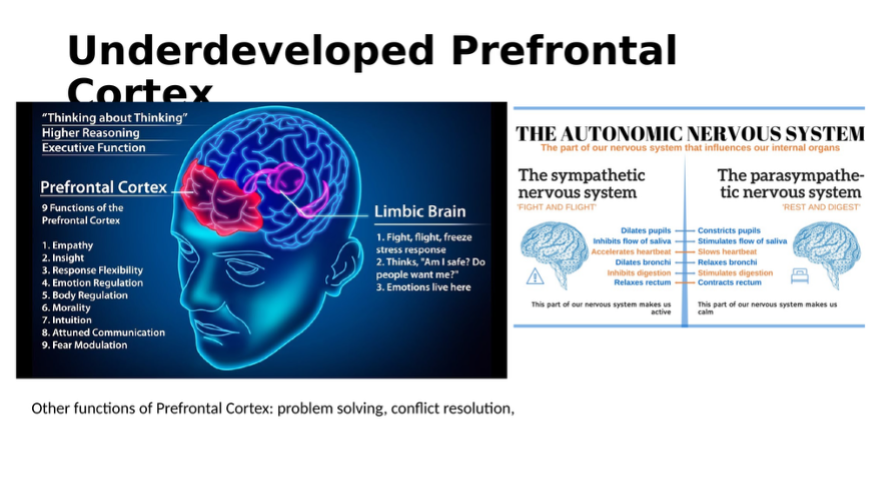
The prefrontal cortex handles problem-solving, conflict resolution, executive functioning, and a long list of other processes — and it isn’t fully developed until age 25. I bring this up mostly so you can extend yourself some patience, because here’s the truth: you are the key. Your kid is going to get overwhelmed quickly and often, and your biggest job — as hard as it is — is to stay calm and manage your own reaction.
I can’t tell you how many times I’ve been in the middle of a hard conversation with my son in his bedroom and had to excuse myself and walk into the hallway before I came unglued. I’d pace, talk to myself, count to ten, pray, grit my teeth, breathe deep, and then go back in and finish the conversation. I wasn’t successful every time. Nobody is. But that willingness to step out and regulate yourself first is some of the most important work you’ll do as a parent.
Fight, Flight, or Freeze
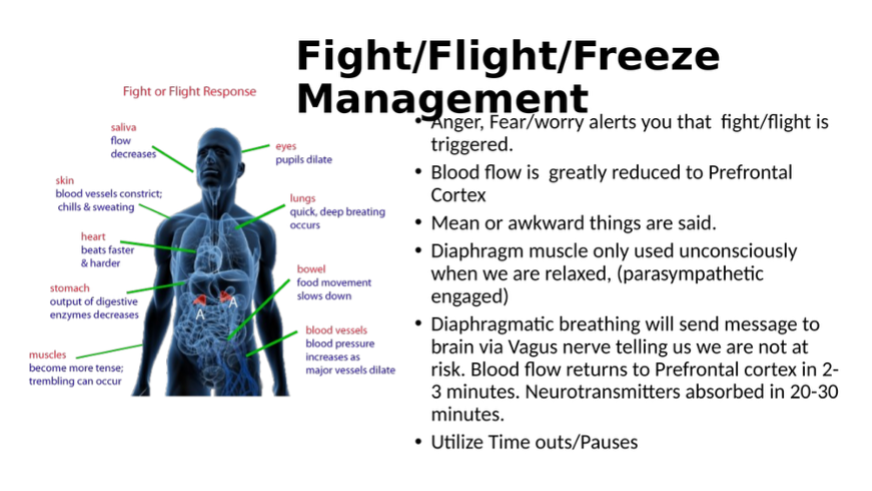
The parasympathetic nervous system is where we want to be, and where we want our kids to be. The sympathetic nervous system is the fight-or-flight response, built for genuinely life-threatening situations — it sends blood rushing to your arms and legs so you can fight or run. Freeze is simply shutting down completely.
The problem is, it doesn’t take a life-threatening situation to trigger fight-or-flight in a kid with ADHD. They’re constantly forgetting things, constantly getting startled — “turn in your paper,” “put your books away, it’s time for a test” — and any of it can flip the switch. The moment you raise your voice, or even shift your tone, fight-or-flight can kick in, and every function of the prefrontal cortex shuts down, because blood flow is heading to the arms and legs instead of the brain.
That’s why we all say something dumb when we’re nervous in a new social situation — the blood flow isn’t where it needs to be. It’s the same reason we say things we regret when we’re angry. There’s no blood flow to the part of the brain that would have stopped us.
Diaphragmatic Breathing: Your Brain’s Off-Switch
Here’s the good news: diaphragmatic breathing sends a message to your brain, through the vagus nerve, that you’re not actually at risk. We only naturally use the diaphragm when we’re relaxed, so deliberately engaging it — belly breathing, where the stomach visibly rises — helps restore that signal and bring blood flow back to the prefrontal cortex. Blood flow typically returns to the prefrontal cortex within two to three minutes; the stress neurotransmitters themselves take twenty to thirty minutes to fully clear.
I tell every client of mine with ADHD that they need to become Olympic-champion deep breathers, because they are going to get triggered constantly, and deep breathing is one of the few tools that can reliably get blood flow back to the thinking part of the brain fast enough to matter. When your child is upset and not listening, asking “why can’t you be reasonable?” isn’t going to work. They genuinely can’t be reasonable in that moment, because the part of the brain responsible for reasoning is, physiologically, offline.
Working Memory: When One Emotion Floods Everything
The third piece is working memory. Sometimes the working memory impairments common in ADHD allow one momentary emotion to become too strong, and the person gets flooded — unable to access the other emotions, facts, and memories that would normally put the moment in context. That’s often why you can’t understand why your child is so upset over something that seems small: it’s not just that they’re emotional, it’s that their working memory is overloaded and they can’t retrieve what they learned from a similar situation last time, at least not until they slow down.
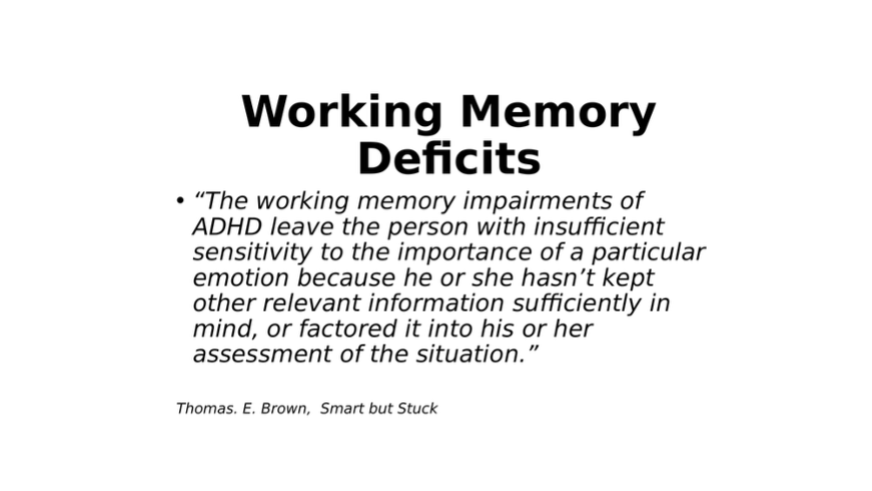
Thomas Brown, one of the leading researchers on ADHD, put it this way: the working memory impairments of ADHD leave a person without sufficient sensitivity to how important a particular emotion actually is, because they haven’t kept other relevant information in mind, or factored it into their read of the situation. In plain terms — they’re not weighing the whole picture. They’re stuck inside one feeling.
Put these three pieces together — a brain that struggles to generate its own motivation chemically, a prefrontal cortex that’s still years from being fully online, and a working memory that can get flooded by a single strong emotion — and you start to see why emotion regulation is so genuinely hard for these kids. It isn’t a character problem. It’s biology. Next, I want to walk through what emotion dysregulation actually looks like day to day, and the specific things that tend to set it off.
Key Takeaways
• A dopamine deficit is why “just try harder” doesn’t work on boring tasks, and why an activity your child loves can produce focus that homework never will.
• Helping a child find what’s consistently compelling to them — not what looks impressive — is a better long-term investment than optimizing their GPA.
• When your child seems unreasonable, it’s often because the fight-or-flight response has physically cut off blood flow to the reasoning part of their brain. Deep, diaphragmatic breathing is the fastest way to help bring it back online.
• Working memory overload is often why a small trigger produces a reaction that seems wildly out of proportion — your child genuinely can’t access the context that would normally calm them down.