
Understanding the ADHD Brain, Why Emotion Regulation Is So Hard
By Bob Smith, PsyD
7-minute read
This is the first post in a four-part series adapted from a talk I gave on ADHD and emotion regulation. I’m writing it for the parents I sit across from every week in my practice, the ones who love their kids fiercely and are, at the same time, completely worn down by the intensity of it. If that’s you, I hope this helps.
Good morning, or whenever you’re reading this. I want to start by telling you who I’m writing for. I have ADHD myself. I’m also the father of a young man who was, for a long stretch of his childhood, deeply dysregulated in his emotions. Raising him was probably the hardest thing my wife and I have ever done. And on top of both of those things, I’m a clinician who works every day with parents and young people who are struggling with exactly this. So, when I talk about emotion regulation and ADHD, I’m speaking to a very specific person in my mind: the parent who is exhausted, worn down, and exasperated by moments with a child who is clearly capable and yet, in that moment, completely out of control.
I want you to know that it can turn out well. My son made it through. When he finally realized he needed to do something with his life, he really got moving, and today he’s doing great, married, three kids, working as a software engineer. I’ll come back to his story more than once, because it’s the thread that runs through everything else I want to tell you.

The Invisible Disability
Here’s the first thing I want you to sit with: if your child had a physical disability you could see, it would change how you responded to their struggles. The visible reminder would help you stay patient. ADHD doesn’t give you that. You can’t see the size of a prefrontal cortex. You can’t see a neurotransmitter deficit. So you forget, and your child forgets, that they aren’t neurotypical, and it becomes very easy to get frustrated or angry with them for something that isn’t fully within their control.
That doesn’t mean there’s no room for discipline. There is. But understanding what’s actually happening inside your child’s brain will help you support them without making them feel stupid or bad for not managing something they may not yet have the equipment to manage.
Life Through a Wide-Angle Lens
I like to describe daily life for a person with ADHD as walking through the world with a wide-angle lens. Everything is coming in, every sense engaged, all the time. It’s exciting. It’s fascinating. It’s also frustrating and overwhelming, and by the end of the day, it’s exhausting. So when your child gets home from school and you ask, “How was your day?” and you get a flat “Fine”, part of that flatness is genuine exhaustion. They’ve spent seven hours walking through sensory overload.
That flatness can look like they don’t care, or that they’re shutting you out. Usually, they’re just spent.
When ADHD Looks Like Ordinary Bad Behavior
One of the hardest parts of ADHD is that the symptoms can look a lot like typical bad behavior in a neurotypical kid, which creates real self-esteem and social problems on top of everything else. Teachers, coaches, and other parents don’t always see the underlying wiring. They just see a kid who won’t sit still, won’t listen, or won’t finish what they started, and they draw the obvious, and wrong, conclusion.
The Teenage "Drama Queen," Explained
Here’s something that helped me enormously as a parent: normal adolescent brain development is what creates the “teen drama queen.” The limbic system, the part of the brain that generates emotion, is fully developed by age 12 or 13. The prefrontal cortex, which regulates emotion, doesn’t finish developing until around 25 years old. So, for over a decade, kids are walking around with a fully operational emotion engine and no governor on it yet.
Picture giving a 16-year-old a 600-horsepower car and telling them to keep it at 30 miles an hour. That’s what we’re asking of every teenager, ADHD or not. Now take a brain that’s already behind on prefrontal cortex development, and you can see why things get dramatic fast.
Impulsivity Isn’t a Choice
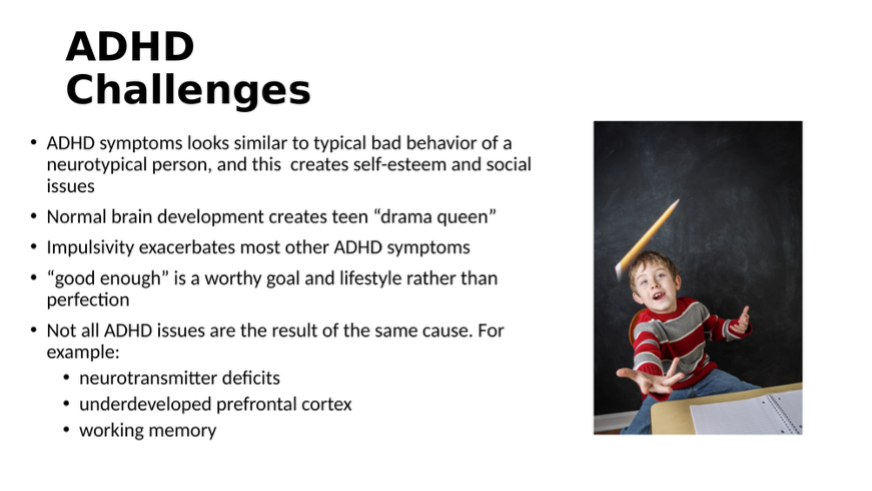
Impulsivity compounds all of it. The kid flipping his pencil in the middle of class isn’t thinking about it. He’s not being defiant; he’s just doing something without the thought that would normally precede it in someone else. You tell him to stop, he walks away, and thirty seconds later he’s forgotten entirely. It looks like defiance. It isn’t.
“How can you forget?” is actually not a fair question, because the honest answer is: they don’t know why. I’ve heard parents say, “I taught you better than that,” and the true response, even if the kid can’t articulate it, is something like, “Yes, you did. It’s not that I didn’t get the lesson. I don’t have the capacity to deliver it right now.”
I know this from the inside, too. Impulsivity got me into a lot of physical trouble growing up, I broke my arm five times as a kid, more stitches than I can count. Five years ago, I was sure I knew how to ride a mountain bike better than I did, went off a jump, and broke my collarbone. I promised my wife: no more jumps. I still ride. I just don’t jump anymore.
“Good Enough” as a Goal
One of the most freeing ideas I share with parents is this: “good enough” is a worthy goal and a worthy lifestyle, not a consolation prize, but an actual aim. The concept comes from the world of object relations theory, and I think it applies perfectly here. It matters far more to help a student find their passion, their talent, and their strengths than to push them toward something they aren’t wired to do.
If your child is genuinely determined to get straight A’s, not for your approval, but because it’s truly in their heart, that’s wonderful. But most people with ADHD can’t get there alone. And that’s not an intelligence problem. A lot of kids with ADHD know exactly what a long-term project requires, quarter after quarter, and fail at it anyway, not because they don’t understand it, but because of everything else that comes bundled with the diagnosis. If they’re aiming high, Stanford, MIT, whatever it may be, they’re going to need help getting there, and there is nothing wrong with needing help. What they need is the humility to ask for it, and it has to be their goal, not yours.
When you can tap into what a child truly loves, they will be remarkably successful in life, even if that success ends up looking nothing like what you originally pictured.
That idea, finding what’s genuinely compelling to a kid, rather than what looks good on paper, turns out to be the key to understanding a lot of ADHD behavior, including why a child can play video games for eight hours straight and fall apart after five minutes of math homework. That’s where I’ll pick up in the next post, along with what’s actually happening physiologically when your child’s fight-or-flight response takes over.
Key Takeaways
• Your child’s neurodiverse brain wiring is real, even though you can’t see it, and that invisibility is exactly what makes it so easy to misread as defiance or laziness.
• The “teen drama queen” isn’t a character flaw, it’s a mismatch between a fully online emotional brain and a prefrontal cortex that won’t finish developing until around 25 years.
• Impulsive moments usually aren’t intentional, even when they look that way in the heat of the moment.
• Aiming for “good enough,” built around what your child genuinely loves, tends to produce better long-term outcomes than pushing for straight A’s or a specific college.